Film Photography News — September 2026 Recap: Polaroid Mod, Phoenix in 4x5, Save $ on Film, and Develop C-41 at Room Temp
| Shelf | Cameras & Lenses |
|---|---|
| Date in | |
| Readers | 910 |
☞ This is the 90th monthly Analog.Cafe Newsletter with the latest film photography lore. Sign up to get it via email on the last Tuesday of every month (it’s free).View this image in HD with GOLDAbove...
☞ This is the 90th monthly Analog.Cafe Newsletter with the latest film photography lore. Sign up to get it via email on the last Tuesday of every month (it’s free).
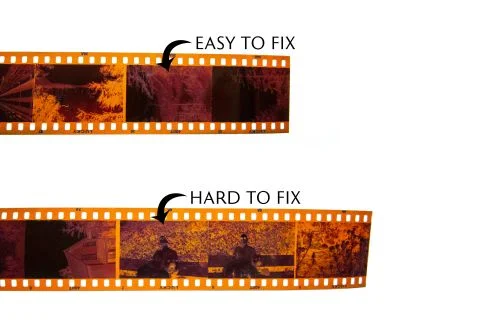
Above: Frames with full density range cause green and orange casts in scans of the new Lucky C400 film. The least-exposed areas can also have blue noise around shadows in inverted images. From this month’s “How to Fix Lucky C400 Film Scans.”
TL;DR: Polaroid Mod is a new camera — launched just now¹! Kyle McDougall got to try experimental sheets of Harman Phoenix and Kentmere 400 in 4x5 — the results are impressive. Photography in search of whimsy is a short essay on the state of culture and technology. I share 27 tips for saving money on film, my complicated and somewhat disappointing experience with Lucky C400, and a formula for developing C-41 at room temperature. Plus, a new app: Flash ⚡️ Exposure Calculator, and an interview with C41 Coffee founder on this month’s Analog.Cafe Podcast.
Get exclusive film photography scoops, learn advanced techniques, science, history, and access powerful web apps for inverting negatives, tracking rolls, and more with the Analog.Cafe GOLD memberships.
In this newsletter: Photography in search of whimsy. 27 tips for saving money on film. Harman Phoenix and Kentmere 400 in 4x5. The problem with Lucky C400. Developing C-41 at room temperature. C41 Coffee (Podcast). Flash Exposure Calculator. Polaroid Mod. Lifetime GOLD membership giveaway. Download and print this newsletter. Latest on Analog.Cafe. Support this blog & get premium features with GOLD memberships!
¹ — The announcement for Polaroid Mod landed minutes before this newsletter was due, so it’s near the bottom of this newsletter. Scroll a little!
Above: Kodak Charmera Millennium Edition.
Photography in search of whimsy.
iPhone “killed” the compact camera lineup in the 2010s, becoming (and remaining) one of the most popular cameras in the world. For a while, it was the smartphone camera and the Canons, the Nikons, and the Sonys of professionally useful DSLRs and mirrorless cameras. But in 2026, the mobile photography market is finally getting some competition from an old impractical design principle: the modern digicam.
Film has been and continues to be at the forefront of going offline, away from the practical, homogeneous selection of thin slippery bricks and ergonomic black boxes, towards an infinite selection of strange and ingenious design choices of the past 200 years. But it’s not the only way to have more fun with a camera.
Creative filters are not enough. Sure, they may help an image appear stylish or interesting, but that’s not the reason a photographer would pay for a camera. Forget what happens after the shutter is released — the object of most importance in the moment is the box with a lens and a button — and those two have been seriously neglected when we switched to thin touch screens with application interfaces and virtual buttons.
There are, of course, lots of impressive cameras still made today — digital and film — whether it’s medium format bodies with tack-sharp lenses or the 2022 Leica M6 for $7,000. But these are not casual cameras, nor are they for everyone.
Despite what you and I may think about photochemistry, film remains a mysterious medium for most. We may love the process of being deliberate and patient; we may be fascinated by the fine details that a physical process renders on a thin substrate. But those are not the only joys of going offline. And as we have recently (re)discovered, there is still something that can perform the simple trick of being a camera in 2026 without the baggage of modern technology that can be conveniently plugged into a laptop.
Above: Shot with the 2010 Samsung WB2000 digicam.
Sensors built in the 2010s are technically inferior — in 2026 that makes them more appealing to some, as their drawbacks, like the low dynamic range, low pixel count, colour shifts, and artifacts, create images that stand out in a way that’s defined by the hardware itself, not a software product made to alter an image that works the same on all supported devices.
Digicams are compact, affordable, fun things. Unlike film, which offers a great choice of affordable vintage gear and chemical processes far removed from modern camera manufacturers, digicams are the new market segment the Canons, the Nikons, and the Sonys have been waiting for.
Perhaps not those three brands yet, but an equally well-recognized giant, Fujifilm, has recently released a $170 Instax Pal 2 that’s a stick-like 1-10MP camera with a tiny lens and presets you can change with a tactile lever.
A well-known professional lighting and camera accessory manufacturer, Godox, has also dipped its toes into the digital market with its unique transparent viewfinder gadget, C100, which sells for $45.
Camp Snap recently launched the 110D with tactile buttons and no screen for $108.
Yet perhaps the best example of success in this category has been the $35 Kodak Charmera, made by RETO, a small Hong Kong manufacturer of (very good) plastic film cameras. Theirs is the smallest and perhaps the most whimsical toy that comes in a blind box.
Digicams are not an alternative to digital photography. It’s the same thing but done in a way that rejects some aspects of modern technology in favour of focusing on just one thing. Perhaps it’s a bridge to the wonderful world of photochemistry.
The path is open in both directions, as the new casual offline photography subgenre may have something for film shooters too.
27 tips for saving money on film.
Thankfully, shooting film does not have to be prohibitively pricey. If you’re looking for a way to shoot more without spending more, a new guide offers tons of ideas to try.
“How to Save Money on Film” goes beyond generic advice, covering all aspects of the process, from picking cameras and choosing film to developing, scanning, and everything in between.
These tips are based on what I’ve learned over the past decade and a half shooting film in Thailand and Canada on vastly different incomes.
Harman Phoenix and Kentmere 400 in 4x5.
Kyle McDougall had recently gotten his hands on Kentmere 400 and Phoenix 2 in large format. Highly experimental, these sheets were cut from a master drum intended for roll film. As such, they are thinner than a typical 4x5 film and could pose issues during scanning on a flatbed, according to the new video.
Likely never to make it to the shelves, Kentmere 400 would be much more expensive on a thicker base required for user-friendly handling, thus defeating the purpose of a budget emulsion. The same may be true for Phoenix (which recently saw a design refresh and a change to the box ISO rating), yet there must be a reason these experiments were attempted, right?
Kyle praised Phoenix in larger format for its softer look, worth shooting even in its current curly form. Perhaps there’s a desire for a touch of whimsy and affordability in the large format community too, as new non-traditional options like the OptiColour 200 appear highly successful.
The problem with Lucky C400.
I’m not trying to be harsh when I say that the new colour-negative film, Lucky C400, has issues.
Compared to Lucky C200, an earlier, slower colour-negative option, C400 is much more difficult to scan. No matter the method, images on C400 come out orange, yellow, green, and even blue in places where they shouldn’tve been.
I bought five rolls of this film and tried all kinds of things to get it to the place I expected it to be. I developed it normally in C-41; I diligently examined the negatives; I developed in ECN-2 and then using the stand method in C-41.
Finally, after shooting it through a blue filter, I found the results that matched my expectations and demonstrated its potential as a photo-realistic colour-negative film.
Read the full story here: “Lucky C400 Colour-Negative Film Review.”
Developing C-41 at room temperature.
While I was experimenting with my Lucky C400 rolls, I decided to try a technique I suspected would lower the overall saturation of the negatives in hopes of gaining more control over the colour casts.
It worked.
Stand development is a well-known technique for developing black-and-white film. It involves lower dilutions, longer times, and a hands-off approach: no agitation needed.
C-41 stand development is a little-known process that adapts that principle to colour-negative film processing — with a few key differences.
Having seen what this can do for unruly films, I invested several more rolls and a chunk of my time dialling in the times and updating the software that helps calculate everything. The result: a tested method for developing colour-negative film at room temperature.
Find examples of stand-developed Fujifilm Superia Premium, Fujifilm 400, Lucky C400, and Ilfocolor 400 along with the recipe here: “How to Develop C-41 at Room Temperature.”
C41 Coffee (Podcast).
Daren and I visited a local coffee shop that’s been a gathering spot for photographers and spoke with its founder, Andy.
We chatted about his business, his relationship with photography, specifically film photography, and his life before Vancouver in Kenya, where he found his love of cameras and the brew.
Find the listen links and the YouTube recording on the Analog.Cafe Podcast page.
Flash Exposure Calculator.
I’ve been thinking about building a simple app that would help set flash exposures for manual film cameras for over a year.
There are many versions of this app available online, but I found most to be unnecessarily complicated or completely unfriendly to the special needs of film cameras.
In hopes of using my flash on the weekend for a friend’s album release party, I decided to dedicate a day to building my version with simple zone-focusing settings, a film-friendly ISO range (1.5-6400), locally saved preferences, and a mini-guide for advanced techniques.
It’s finally done.
As with the rest of the apps I build, it works anywhere you can start a web browser. Flash ⚡️ Exposure Calculator is hand-coded and 100% free to use.
Polaroid Mod.
Speaking of flash and whimsy in photography, Polaroid has just released a new camera that closely resembles, or is based on, the Polaroid Now I-Type series, with some new creative features and a design refresh.
The main feature is the Creative Modes dial, a bright yellow ring around the lens of a silver-and-grey camera. This control lets you quickly switch from normal shooting to Double Exposure, Motion Freeze (a second-curtain shutter drag — essentially a long exposure followed by a flash), Light Painting (long exposure), and Split Shot. Split Shot is a double-exposure mode that works with an included accessory mountable on the lens, which splits the scene into two by covering up half, and then rotates to cover the other half after the first exposure is taken (much like the Lomography Splitzer).
The exposure compensation dial has also gained prominence by becoming a beefier, easier-to-grasp feature, instead of a tucked-away tool.
Though marketing or the instruction booklet never mention this, the camera must be selecting very small apertures to create long exposures in well-lit spaces. Or, it may not work in daylight. I sent the company an email about this and will update this post if they reply.
Polaroid Mod is available on the company website today for $169.99.
Lifetime GOLD membership giveaway.
In celebration of the 200th year of photography (1826-2026), I’m giving away FOREVER-FREE lifetime passes for Analog.Cafe GOLD memberships!
There are 12 of them, announced monthly in this email — throughout 2026 only.
This month’s winner of a lifetime GOLD membership on Analog.Cafe is:
Howard 🎉🥳
Congrats to you! I’ve applied a perpetual 100% discount to your account so you can enjoy all the Analog.Cafe features for $0/mo going forward.
GOLD memberships include access to web apps for negative inversion and chemical logging, all articles on this website in printable PDF format, and exclusive film photography content.
You, the reader, can also win this prize. To enter, you just need to be an existing member or sign up!
Download and print this newsletter.
GOLD members can download this newsletter as a high-resolution PDF file. Open this newsletter in your browser and click the “Download PDF” button at the top.
Hope you found this email a helpful and fun read. Feel free to add a comment or reach out anytime. 👋