The Dark Side of AI: Copyright Concerns Among Nature Photographers
| Shelf | Editing & Software |
|---|---|
| Date in | |
| Readers | 567 |
AI-generated alterations of wildlife images are misleading the public and infringing on photographers' rights, raising serious copyright issues.
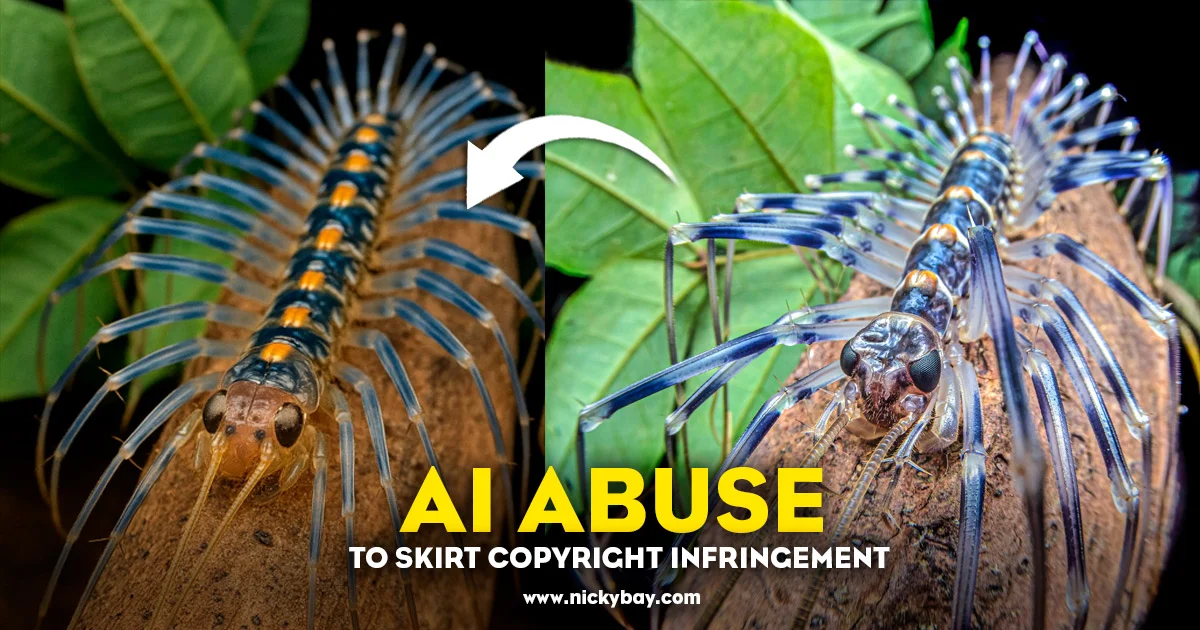
Artificial Intelligence (AI) has undeniably increased the convenience of various tasks, yet it poses significant challenges, particularly for professional photographers. Recently, instances have surfaced where AI alters wildlife photographs, creating misleading content that is circulated on social media. This manipulation not only violates copyright but also blurs the lines of what constitutes derivative work, especially since image variations can easily stem from AI prompts.
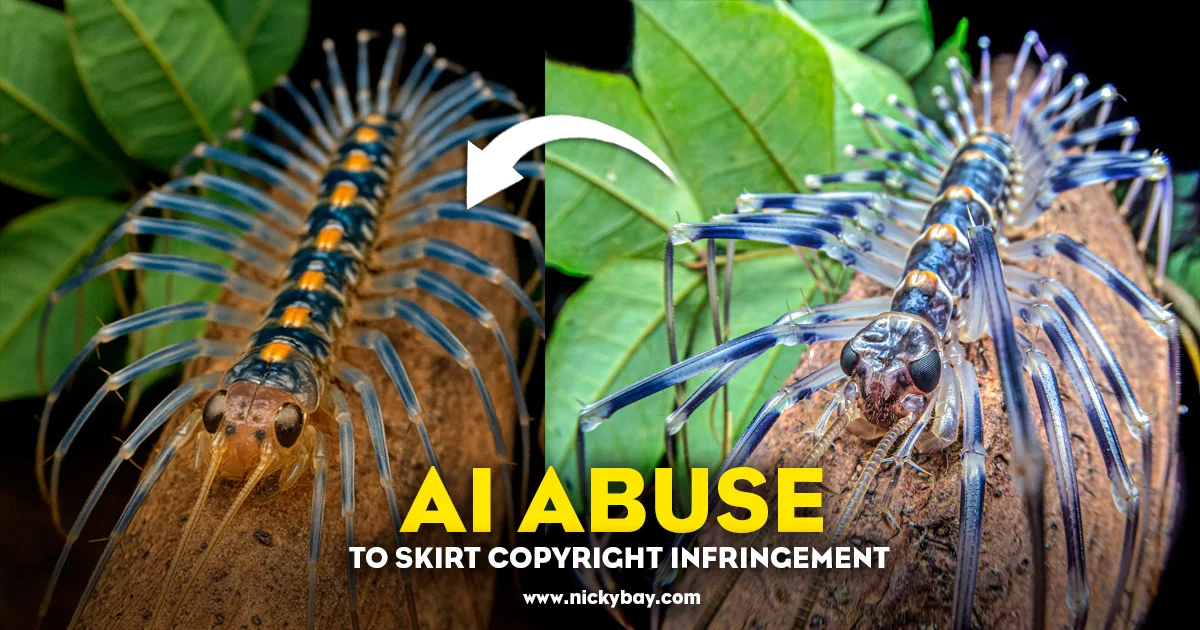
Multiple well-known nature photographers have recently illustrated instances where their original works were not just misappropriated, but manipulated into confusing versions dubbed “AI-nonsense” by individuals seeking to avoid copyright infringement. The newly generated images, often paired with AI-generated captions, end up disseminating incorrect information, leading the public to believe in fabricated narratives surrounding nature's beauty.

One glaring issue is the gross deviation in accuracy regarding anatomical details in AI-generated images. The AI often distorts key features, producing results that lack fidelity to the original subjects. Below, I will showcase several examples including my own photographs alongside those from other distinguished photographers, providing insights into how these images were altered. I extend my gratitude to Chien C. Lee, Gil Wizen, and Nick Volpe for permitting the inclusion of their works.

Long-legged centipede (Thereuopoda sp.)
Long-legged centipedes exhibit a high level of skittishness and speed. The ideal moment for capturing a close-up shot occurs shortly after they moult, revealing brilliant colors and a temporary tolerance for photographers. Unfortunately, the AI representation displays incorrect eye and antenna placements, misidentifying the subject as a Scolopendra, which is not accurate. To view an authentic Scolopendra, click here.
Stink bug eggs (Pentatomidae)
Stink bugs typically deposit their eggs in clusters. Following hatching, the offspring huddle around the eggs, forming a unified structure that offers some deterrence against predators. The AI-generated image notably lacks essential details that would otherwise highlight the unique face-like patterns present on the eggs before they hatch.
Whip-tailed spider (Ariamnes sp.)
Typically, whip-tailed spiders can be observed elongated and suspended from silk like dried twigs. This specimen is significantly larger than many species, reaching roughly 40mm in length. While the AI version appears remarkably accurate, it portrays incorrectly bent legs at tibia IV, and the caption references an unrelated species, Dolophones.
Notodontid caterpillar (Notodontidae)
Known for their exceptionally long posterior appendages, notodontid caterpillars often display these features during movement. The exact purpose of these appendages remains a mystery.

Orb weaver spider (Parawixia sp.)
This striking orb weaver from the Parawixia genus was photographed in Peru. Current taxonomy suggests that while some Parawixia species are housed in Southeast Asia, those native to the Neotropics may soon be reclassified into a different genus. Despite the AI's attempt, it frustratingly alters vital spider characteristics without losing resemblance.

Corklid spider (Cyclocosmia sp.)
This spider previously circulated online with dubious claims regarding its aggressiveness. Contrary to those rumors, it is notably harmless. The AI-generated version depicts exaggerated inaccuracies in the spider’s eye structure, diverging from any known morphology.

Moulting cicada (Huechys fusca)
Encounters with molting cicadas are immensely rare. After molting, their wings have a brilliant white color that will transition to black within minutes. The AI-generated image diverges enough from the original, potentially contributing to its rarity in photography.
Tree stump orb weaver (Poltys elevatus)
Famed for its impressive camouflage, Poltys elevatus possesses a specific shape allowing it to blend seamlessly with dried branches as it hunts. This AI-generated representation disappointingly misplaces many eyes from their natural positions.
Long-horned orb weaver (Macracantha arcuata)
This species is notable for its remarkably extended horns, a trait that offers protection against predation. The AI-generated caption erroneously refers to the spider as a longhorned treehopper.
Moulting golden orb weaver (Nephila pilipes)
This species is perhaps the most prevalent of all golden orb weavers. Upon molting, its legs appear extremely vibrant and straight. The AI-rendered version misidentifies a random species, inaccurately blended from different genera.
Dragon mantis (Toxodera integrifolia) © Chien C. Lee
Dragon mantises are incredibly rare, typically residing in the forest canopy. They are among the most colorful mantids. The original photo, shared by Chien C. Lee, captures the true beauty of this species.
Mating stick insects © Nick Volpe
Nick Volpe has eloquently highlighted the problem of AI misuse in photography, emphasizing the importance of supporting authentic wildlife photographers. His post contrasts a genuine image of mating stick insects with its erroneous AI counterpart. Follow his website NLWild Nature Media and his Facebook page Nick Volpe Wildlife Photography for more insights!
Armored katydid (Cosmoderus maculatus) © Gil Wizen
This species showcases a distinctive thorax lined with striking spikes. You can view the original, authentic photograph captured by Gil Wizen, who was among the first to raise awareness on this AI abuse issue, pinpointing similar concerns addressed here.


Conclusion
While the technological advances provided by AI offer potential benefits, they are marred by individuals who misuse this technology to generate misleading content. The internet is already cluttered with misinformation and cannot afford an increase in fabricated content. Although it may be impossible to eliminate these malicious acts entirely, there is a pressing need for social media and content platforms to implement measures to combat this issue.
As we navigate through technological advancements, the problems associated with them become apparent. It’s crucial that effective countermeasures against such abuses are established promptly.
AI can serve productive purposes, but its misuse for misinformation cannot continue. Stay informed and prioritize original content creators over those spreading inaccuracies.


