Mastering Room Temperature Development for C-41 Film: A Stand Recipe Guide
| Shelf | Cameras & Lenses |
|---|---|
| Date in | |
| Readers | 443 |
Discover a simplified room temperature approach to developing C-41 film, exploring results on saturation and photograph control in this comprehensive guide.
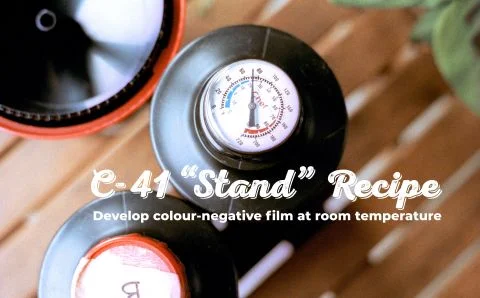
Developing color-negative film typically requires heating chemicals to about 39℃ (102℉) and involves consistent agitation every thirty seconds. However, this guide presents a modified C-41 development method that enables processing at room temperature. This approach not only makes the process more convenient but also allows for a touch of flexibility in your workflow.
Benefits of Stand Development at Room Temperature
For many photographers, using tools like sous vide machines or water baths can complicate the development process due to spatial constraints and the need for electrical outlets. Switching to room temperature development allows you to create your film on a balcony or another space without being tethered to those considerations. This newfound freedom gives you the luxury to attend to other tasks while the film develops, as agitating the chemicals is not necessary.
Does Developing C-41 Film at Room Temperature Change Its Look?
The answer is a definitive yes. Through testing various films such as Fujifilm 400, Fujifilm Superia Premium, Ilfocolor 400, and Lucky C400, noticeable changes have been observed. The primary alteration is a reduction in saturation, which might be viewed as a tradeoff for the convenience of stand development.
Contrary to expectations, the stand development method did not compromise the contrast in any of the films tested. While many assume that lowering the development temperature may reduce the overall contrast and sharpness, this method has proven otherwise. This is particularly surprising when compared to stand development in black-and-white film, which is known to decrease contrast.
The minor loss in saturation, however, can be easily compensated during post-processing, as reintroducing saturation is quite manageable without degrading the image quality significantly. This could even simplify color correction during editing, making it easier to tweak the images toward your desired look.
Practical Application: Effective Color Correction
For instance, during my experience with the Lucky C400 film, which exhibited a stark blue noise in the deep shadows, the stand development technique provided better control over color shifts, an aspect that proved challenging to edit under normal conditions. While this process didn't eliminate every issue, it did mitigate some undesirable color artifacts, enabling a more straightforward correction process.
Consistency Across Film Types
Thus far, trials with the four distinct films show that this stand development approach yields consistent results: reduced saturation combined with stable contrast. Given that the standard chemistry is applied within a varied timeline, it’s reasonable to expect this outcome across all films formulated for the C-41 process. Nevertheless, ongoing testing will add valuable insights as I continue to explore more film samples.
Testing and Future Directions
As I move forward, I’ll also investigate the implications of push- and pull-development techniques, alongside semi-stand development variations. Each method offers intriguing possibilities for refining and perfecting film processes, adapting to different artistic requirements and outcomes.
C-41 “Stand” Recipe: Times, Temperatures, and Techniques
Here’s how to conduct your stand development:
- Film temperature prior to development: Room temperature (approximately 20-24℃).
- C-41 developer temperature: Same as the film's temperature.
- Development time: Approximately 2 hours.
By following these guidelines, you can achieve reliable results without needing specialized equipment while taking advantage of the flexibility that room temperature development offers.
All samples discussed in this article were scanned with a Nikon SUPER COOLSCAN 5000ED and inverted using film Q, ensuring no color corrections were applied during this process. Note that inversions were completed via histogram stretching, preserving the authenticity of the results.
In summary, by adopting the stand development method for your C-41 color-negative film, you can simplify your workflow, maintain control over image quality, and achieve consistent results across different film stocks. It's a practical alternative that deserves consideration in every developing photographer's toolkit.