Insights from Using Rollei Infrared Film: An Analytical Guide
| Shelf | Cameras & Lenses |
|---|---|
| Date in | |
| Readers | 695 |
Explore 38 insightful frames shot on Rollei Infrared film, highlighting key lessons learned about exposure, focus, and the challenges of infrared photography.
Rollei Infrared is a high-speed black-and-white film designed for infrared photography, allowing sensitivity up to 750nm on the light spectrum. This feature can create striking contrasts, making foliage appear luminous while rendering water dark when correlated with a dense red filter. As my affinity for infrared photography deepens, I've come to appreciate its cost-effectiveness compared to color infrared films like Kodak Aerochrome. However, challenges arise as the infrared light is invisible to the human eye, making successful exposures more elusive but incredibly rewarding.
The “Wood effect,” where vegetation appears radiant against darker backgrounds, harks back to the insights of physicist Robert W. Wood, who noted the stunning visuals of infrared photography. He aptly described the contrast of bright landscapes against a darkened sky, a signature aesthetic of infrared photography.
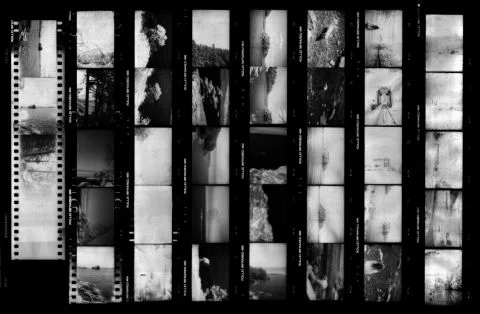
This article showcases 38 frames from one roll of expired infrared film, critiquing successes and missteps along the way while uncovering nuanced lessons about shooting with this film.
Examining the Roll
Each frame presents an opportunity to reflect on various aspects of photography, such as exposure and composition, and how they play into the unique characteristics of infrared capture.
Light Leaks
Frame one is marred by significant light leaks at the edges, a common issue for film loaded in certain camera cartridges. Fortunately, the subsequent frames display considerable improvement as the film progresses deeper into the cartridge, shielding it from stray light.
Focus and Exposure Verification
The second frame shows that although edge burn remains, my focus and exposure settings were accurate, setting a firm foundation for subsequent images.
Weak Infrared Effect
In frame three, while the light leaks have minimized, the infrared effect lacks prominence, resembling traditional black-and-white film instead.
Lackluster Composition
Frames four and five fail to captivate, presenting a view of ordinary ships without compelling composition.
Haze and Blur Challenges
Frame five stands out due to evident Wood effect in the foliage, yet suffers from a lack of sharp focus and motion blur from a fast-moving subject captured at 1/250s. Moreover, weather conditions and the film's sensitivity to humidity contributed to an overly light sky.
A Focus Misstep
Frame six shows the consequence of suboptimal focusing; my settings targeted nearby branches, leaving distant features somewhat out of focus—a notable risk with a 50mm lens at an f5.6 aperture.
Busy Composition
Frame seven introduces interesting elements, hinting at the Wood effect, but ultimately feels cluttered and lacks detail due to noticeable grain. Envisioning this image on a larger format could yield striking results.
Dynamic Range and Overexposure
Frame eight suffers from poor scene choice for the film, needing significant brightness adjustment to accommodate the limited dynamic range and harsh highlights.
A Fun but Mediocre Shot
In frame nine, using the Sunny 16 rule yielded good focus amidst a challenging environment. The resultant photo tells more of a personal history than a universal narrative.
Missed Moments
Frame ten captures an eagle; however, my setup focused on the incorrect exposure parameters. Luckily, frame eleven rectified this oversight.
Eagle Through Foliage
Frame eleven presents a decent capture of an eagle, although low contrast diminishes its potential impact, influenced by harsh lighting and lens flares.
A Reason to Retry
Frame twelve emphasizes the Wood effect beautifully, providing significant depth with detailed foliage reflections, displaying a nice interplay of contrasts. Focus refinement adds to its appeal, although composition adjustments could enhance its overall effectiveness.
Near Perfection
This concludes the analysis of my infrared photography journey with Rollei Infrared film, demonstrating valuable lessons in exposure, focus, and compositional storytelling within the unique spectrum of infrared light.